
by Fred Brewer | Jul 15, 2015 | Client Tips
What’s the one thing that (most) consumers love and (many) business owners hate? Reviews.
82% of consumers read reviews for local businesses, so obviously reviews matter. That’s not even a question at this point. But what’s frustrating for many small businesses is how hard it is to get enough positive reviews to make a difference.
Most of us go through what we refer to as “The Stages of Review Hell,” and end up trying some costly things: like offering incentives for reviews. What are “The Stages of Review Hell” and how can the last stage get us into big trouble? Let’s take a look…
The Stages Of Review Hell
Denial. Maybe if I ignore them, they’ll go away. It seems like everyone starts in this stage, but you can’t afford to stay here. Remember, the majority of consumers are checking reviews before deciding who they want to do business with. Reviews matter, whether you want them to or not.
We think Mary Bowling, one of the industry’s best local search experts, said it best:
“Small business owners who aren’t actively marketing on the Internet are impacted by online reviews and ratings whether they want to be or not, because even enterprises without websites are being talked about online.”
If you’ve been hanging out in the denial stage, it’s time to move on to the next stage.
Begrudging Acceptance. This stage may not sound better, but it’s a natural part of the process. When you’re here, you’ve acknowledged that online reviews matter and are going to affect your business, whether you personally give them much validity or not. Once again, Mary Bowling forces us to face the facts:
“All businesses and those who market them must get used to the fact that reviews are not going away – not ever.”
Ok, so if they’re not going away, what do you do?
When you find yourself in this stage, maybe you start to occasionally ask satisfied customers to write reviews if they think of it and have the time. As time goes on, asking doesn’t seem so intimidating, and you start to do it with a little more ease and poise. You give it a good college try and make it part of your service process, but after awhile, you start to wonder why you’re not seeing much of a difference, and what you can do to get people to follow through.
You’re already stretched thin and now you’re feeling frustrated and victimized by Google, Yelp, and all the people “deciding” what rules your business has to play by. So, you decide to take matters into your own hands and step right into the next stage.
Desperation. You’ve tried to play by the rules, but you’re still way behind your competitors in reviews…what can you do? During the desperation stage, you try everything. You start out handing out review cards, sending post cards. And then one day it hits you: What about bribes? No one is taking the time to give you the reviews you so desperately need, but you could give them a little incentive! Or, even better, what if you just hired someone to leave fake reviews for your business or took matters into your own hands and left some reviews yourself? Is there really any harm in that?
Deceit AKA Danger Zone. If you’re guilty of (or even considering) hiring cheap labor to fake reviews, writing reviews yourself, or incentivizing reviews and giving rewards and gifts to those that take the time to leave you a review online, you’ve passed from the desperation stage to the deceit stage, AKA “the danger zone”.
Slow. Your. Roll.
Yes, you need reviews, but are you willing to pay $300,000 for them? $300,000? Yes, you read that right!
Businesses that produce fraudulent or incentivized reviews are being penalized with more than just a slap on the wrist. The powers that be are hitting companies with massive fines, stripping them of all their reviews, and even sabotaging their page rankings. Is it really worth it?
Back in 2015, AmeriFreight was fined $300,000 by the FTC for failing to disclose that they’d given cash discounts to customers in exchange for reviews.
The FTC stated the following:
“Companies must make it clear when they have paid their customers to write online reviews…If they fail to do that – as AmeriFreight did– then they’re deceiving consumers, plain and simple.”
See, we didn’t just pull that number out of thin air. Talk about a costly mistake!
In this same statement, the FTC decided to lay down the law for those taking the “money talks” route, in order to keep consumers in the loop. If you have incentivized reviews, you are required to label them according to the following guidelines:
- A. In textual communications (e.g., printed publications or words displayed on the screen of a computer), the required disclosures are of a type, size, and location sufficiently noticeable for an ordinary consumer to read and comprehend them, in print that contrasts with the background on which they appear;
- B. In communications disseminated orally or through audible means (e.g., radio or streaming divaudio), the required disclosures are delivered in a volume and cadence sufficient for an ordinary consumer to hear and comprehend them;
- C. In communications disseminated through video means (e.g., television or streaming video), the required disclosures are in writing in a form consistent with subparagraph (A) of this definition and shall appear on the screen for a duration sufficient for an ordinary consumer to read and comprehend them;
- D. In communications made through interactive media, such as the Internet, online services, and software, the required disclosures are unavoidable and presented in a form consistent with subparagraph (A) of this definition, in addition to any audio or video presentation of them; and
- E. In all instances, the required disclosures are presented in an understandable language and syntax, and in the same language as the predominant age 4 of 7 language that is used in the communication, and with nothing contrary to, inconsistent with, or in mitigation of the disclosures used in any communication of them.
You know how bad your Yelp page looks to potential customers with zero reviews? Imagine how it will look with language like, “This reviewer was paid handsomely to provide this 5 star review.” Or, imagine what it would look like with this message that Yelp puts on pages it suspects of incentivizing reviews:
“We caught someone red-handed trying to buy reviews for this business. We weren’t fooled, but wanted you to know because buying reviews not only hurts consumers, but also honest businesses who play by the rules. Check out the evidence here.”
Is that announcement going to make your company look good to potential customers? No, siree bob.
How Can You Get More Reviews, Without Breaking The Rules?
Maybe you’re thinking, “Not everyone is getting fined. Some people are getting away with it and all those fake and incentivized reviews are helping their businesses in search.”
You’re right. There’s Sunday Riley, and the boatloads of businesses racking up fake and incentivized reviews on Google and Amazon without punishment, but the point is: it’s not worth the risk.
What should we do instead? Here are some tips to help you rake in the positive reviews without being penalized:
- Ask at the right time. Did your customer just finish telling you how over the moon they are with your service? Now’s the time to ask for a review! Don’t wait until the thrill is gone or too much time has passed. Word of warning: Yelp is so serious(ly weird) about this that they don’t want you even asking for reviews. We won’t try to understand their logic – we’ll just say, leave Yelp out of the conversation when asking for reviews, and stick with Google, Facebook, or another platform.
- Make it easy. If your customer gets frustrated during the review process, they’re likely to bail. So make it easy. Whether that means including links to multiple review sites in your email signature, leaving behind a card with instructions on how to leave a review, or using some other method. Don’t corner them, just let them know that you’d appreciate a review on whatever platform they’re most familiar and comfortable with. It’s better to have reviews on multiple platforms anyway, and if it’s easy for the customer, they’re much more likely to follow through.
- Make your customer feel important. Everyone likes to feel important, so make your customers feel important during your “ask.” Let them know just how much you value their feedback and how important it is to you as a company. Not only that, but let them know that their feedback/review helps other people in their community decide who to do business with. The more you emphasize their role, the more inclined they’ll be to “make a difference” by leaving a review.
- Provide an amazing experience. In the struggle to get more reviews, many business owners forget what’s really important: your service! If you’re providing a customer experience that goes above and beyond, your customers will want to share, be it in social settings, on Facebook, or on a review platform like Yelp or Google. Anytime you can “wow” your customer, you should – more reviews will naturally come from excellent service.
- Get some help. There are great tools out there like GatherUp that make it easier to get reviews and keep the valuable feedback for your company coming. If you’re struggling to get reviews and want a little help, check it out.
If you do have a review method in place, be sure that you’re playing by the rules and keep at it! It may take some time, but play fair, stay focused on providing the best customer experience, and remember: Ask, and you shall receive.

by Fred Brewer | Feb 26, 2015 | Client Tips
So you’re waiting for that big business boom to send profits through the roof so you can start living the good life. Well, no matter what you’re doing marketing wise and SEO wise, if you’ve forgotten about customer service, you can kiss the good life goodbye, because that big boom is never going to come.
Think about it: you could have the best industry experts at your disposal, the best logo, the best website, and the best coupons and offers, but if you treat your customers poorly, what do they care about any of the rest of that stuff? The truth is: they don’t.
Here’s the one thing that can’t be ignored or denied: good customer service is key to customer loyalty and satisfaction. Whatever your industry or location, you client has more choices when it comes to deciding who to do business with than ever before. Why would they choose you if you offer a train-wreck experience?
Wait, it’s the 21st Century and We Have the Internet. Is Customer Service Still Important?
We’d argue that it’s more important than ever for that very reason.
As many as 90% of people claim to use the Internet to research local businesses and determine who to hire or purchase from. And they aren’t just reading your website – they’re reading what others are saying about you. Depending on your level of customer service and the overall experience you offer, this can be a good thing or a bad thing.
When your customers have a great or horrid experience with you, guess what they’re going to do because it’s the 21st Century and we have the Internet? They’re going to Tweet about it, Yelp about it, update their Facebook status about it, or leave you a Google review. And you can bet that they’ll have a greater reach than you do.
If you really want to see your business thrive and boost profits, it’s time to take a good hard look at the customer experience you’re providing.
According to Bain & Company, the way that you treat your customers is even more important than the product or service you are providing them with:
A customer is 4 times more likely to defect to a competitor if the problem is service-related than price- or product-related. [Source: www.beyondphilosophy.com]
That’s right: customer service is even more important than the price and the product. Your customers are valuable, but when they receive bad customer service, they certainly don’t feel that way. And if they feel under-appreciated and like you don’t care about their satisfaction, they WILL take their business to someone who does care. But not before letting everyone else know about their experience.
What’s Good Customer Service Look Like?
People try to complicate things, but good customer service is as simple as following the golden rule – treat others the way you’d like to be treated. Make sure that each and every one of your customers knows just how much you value them, because without them, you have no business. In other words, Mom was right – it does pay to be nice. Here are some more tips to help you meet client expectations and gain more and more happy, loyal customers:
#1 Provide quick and helpful service
Even the most patient among us wants access to help when we need it. Now obviously you may not have the funds or the staff to provide 24 hour support, but the quicker you can respond to customer inquiries, the less likely that customer is to go to another company that offers the same product or services.
We’ve seen customers rant on Yelp and other review sites and give businesses a 1-star rating, without ever actually doing business with them. Why? Because they contacted customer service, fell through the cracks, and felt like they were ignored. Whether it was intentional or not, that’s business lost, and others will read that review or at least see the effect of it on the overall business rating.
Now, speed shouldn’t be a trade-off for usefulness. If you can’t provide effective and helpful support right away, wait until you can! You can always send an email letting the customer know that you’re working to quickly get the information needed to support them and that you will be contacting them shortly with a solution.
#2 Be where your customers are
We all have different lives, different schedules, and different preferences for receiving help. Why only offer your customers one way?
Do you know how your customers prefer to be helped? By offering several methods for a limited time, you should be able to gather some data showing what your typical customer prefers, by documenting how many choose one method over another.
You may not need to invest in a TikTok or start a company forum; studies show that the majority of customers still prefer a phone number to call, an email address to contact customer service, or a live chat. So do some experimenting and see what resonates with your customers.
#3 Listen to you customers
We know it’s not an innovative or original idea, but have you tried listening to your customers? Not all ideas or suggestions that come from customers will be beneficial or even practical, but you can learn a lot about what your company or brand is missing or could improve upon by listening to your customers.
Sometimes you can be too close to the brand, or too stuck in the business-running side of things to see what may be obvious to customers and potential customers. Listen and observe your customers and you could learn a lot about what people want and how to best deliver it to them.
Don’t Forget To Ask Your Customers for Reviews & Referrals
Now that you’re ready to knock customer service out of the park, how can you make sure you’re getting great reviews and referrals that reflect the amazing customer service experience you provide?
Ask!
People everywhere want to feel like they are contributing to something bigger and like they are part of a group. Asking for referrals helps meet that need and helps boost your business simultaneously. But don’t assume that satisfied customers will go out and refer on their own. Unsatisfied customers are much more likely to share their experience on their own initiative. The customers that had a great experience with you might need a little push.
Word of mouth is still the best way to build business, and if you ask a happy customer to refer your business, you make them feel important and valuable to the business. It’s a win-win. Not only will this help build loyalty with that specific customer, but you’ll also end up with more loyal customers as a result of the referral. It’s contagious.
Studies also show that referred customers are 18% more loyal than customers gained through another method, and they tend to purchase more over time. So make “the ask” for referrals a normal part of your customer service experience.
Of course, we can’t forget about the ultimate referrals: online reviews. Reviews hold a lot of weight, both in terms of search rankings and customer decisions. In fact, 89% of 35-54-year-olds trust online reviews as much as personal referrals.
So what’s that mean for you? It means you should definitely work on getting more reviews for your business.
The secret to more reviews is the same as the secret to more referrals: You’ve got to ask. 76% of people who are asked will leave a review.
Of course, if you’re struggling with getting reviews, there are things that can help. For example, you could reduce the amount of time between the service and the call to action, and consider a way to make it easy for your customer.
Some business owners find success through platforms like GatherUp, or by leaving behind cards and including links to their GBP listing and other review sites in their email signatures. See what works best with your customers.
And while you’re at it, why not ask your satisfied customers for testimonials that you can put on your website and social media pages? When you put testimonials and reviews directly on your website, you don’t have to worry about platforms like Google or Yelp deciding which reviews to filter and which ones to show. Your customers will see them all.
What Should You Do if You Get a Negative Review?
According to the latest BrightLocal Local Consumer Review Survey, 91% of customers say positive reviews make them more likely to use a business, while 82% say negative reviews make them less likely to use a business. So if your customers are saying good things about you, then you’re golden; if they’re leaving negative reviews, you need to make it right.
But it’s not necessarily the negative review that could hurt business – it’s how you respond to it. The worst thing you can do is ignore a negative review or simply move on.
In the words of Scott Stratten, best-selling author and president of UnMarketing,
“It’s not usually one thing that makes you leave a company; it’s a combination of issues and no resolution, or no satisfactory resolution to those issues.” [Source: “Unselling” Brainfluence Podcast With Roger Dooley]
Remember, you want every customer to feel like they matter, because they do! Ignoring a negative review and leaving your customer with their frustration is not how you show someone they matter.
The best thing to do when one of your customers feels they have received bad customer service is to address it quickly and calmly, and try to make it up to them. The good news is that 70% of customers will do business with you again if you make it up to them.
How do you do that?
If your customer complained online by leaving a negative review or comment on your Yelp, Google, or Facebook page, it’s important that you address it online so that other customers or potential customers can see that you care enough to try and make it right. Do NOT ignore the negative review and simply hope it will go away. Instead, express your apologies for the negative experience, emphasize that it is not a standard experience for your customer, and ask them to contact you directly so that you can make it right.
In other words, let them (and everyone reading the review going forward) know that their satisfaction matters and that your goal is to provide excellent customer service each and every time.
One thing you’ll certainly want to avoid is a back-and-forth online. Never argue or get defensive. This will not only upset the customer further, but it will make you look childish and unprofessional to anyone considering doing business with you.
Taylor Hill, one of the founders here at Spark Marketer regularly reminds business owners, “Do you want to be right or do you want to win?” If you’d rather be right, be prepared to lose customers.
Don’t Ignore the Things That Matter Most: Get Customer Service Right
So, how does your business stack up in terms of customer service? Whether you’re feeling pretty proud or pretty defensive right now, it’s a good idea to periodically stop and give this area of your business a good look.
Quality customer service is something that requires daily effort and practice, but just like you condition your body, you can condition your business to intrinsically provide top-notch customer care. So take the time to motivate and train your employees, and always be looking for ways to make the customer experience a good one.

by Fred Brewer | Dec 16, 2014 | Client Tips
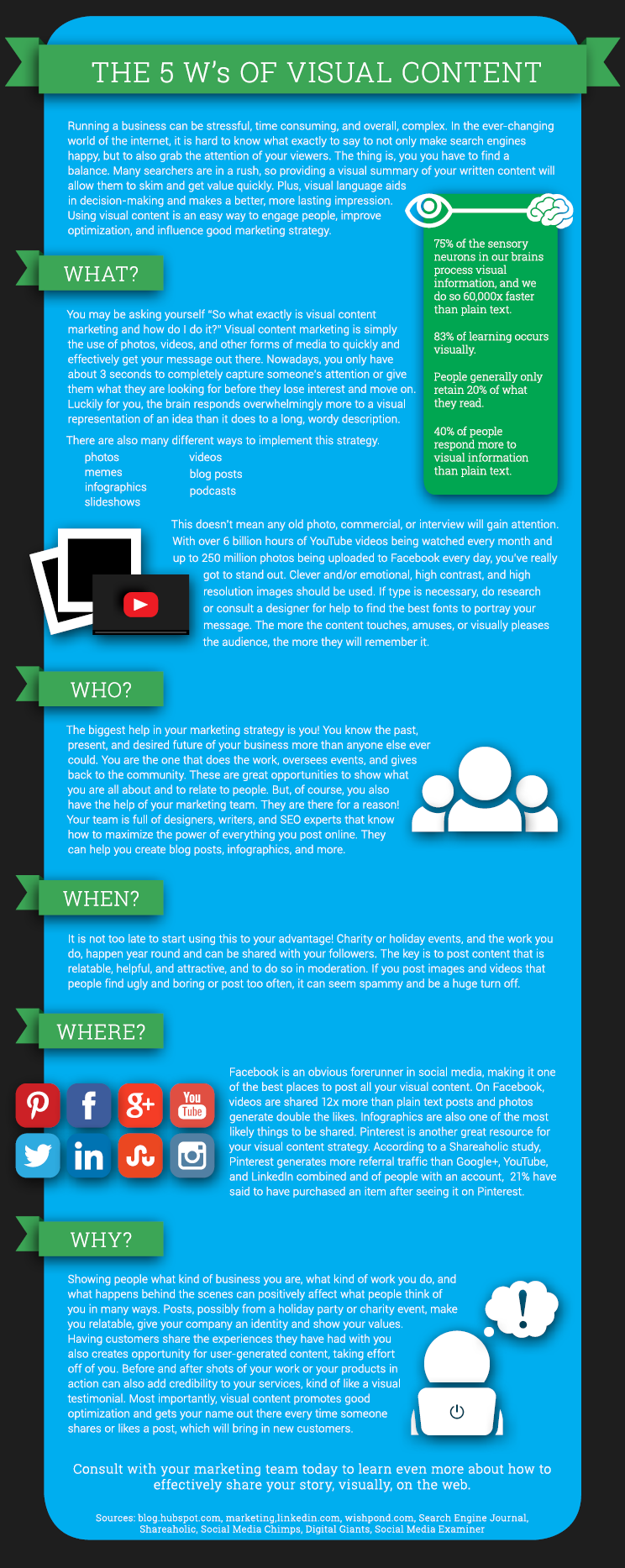
Visual content can help you potential customers connect with the information you’re giving them. When putting together yours, consider the 5 W’s of visual content.

by Taylor Hill | Oct 8, 2014 | Client Tips
One of the things I find extremely interesting is the number of small business owners who are out of touch with their marketing efforts, both online and off. It’s more than having an ad or making a payment to the same marketing company that you’ve made payments to for years. It’s understanding the metrics and data, and comparing it to other data sources in order to make good decisions moving forward.
It is about knowing who your customers are and what they truly want, and understanding how they shop for your services or goods. It’s about putting out consistent messaging on your business cards, your ads, your website, and your social sites in graphics and words.
Yet for many very overworked small business owners, it’s just easier to hand your marketing over to whoever is the cheapest or the easiest to deal with — to just get something done and “out there.” After all, if you throw it “out there,” someone will eventually see it and call or click. At least that’s what you’ve been told, or what you want to believe because you’ve just spent a lot of money on that approach.
The problem is that when you are dealing with multiple people and companies, it’s easy to duplicate efforts and have multiple ads showing up on the same websites. You can easily end up with a bunch of different ads with different logos and messages because you left the creative to each marketing business you are working with.
This does not mean your marketing vendors are not professional or don’t know what they are doing. It means you haven’t taken responsibility for your own company’s messaging. Here’s the thing: you are the business owner, the one responsible for making the decisions that surround and affect your business. To paraphrase Harry Truman, the buck stops with you.
Do You Know What Your Message Is?
Message development is one of the foundational principles of any business marketing effort. Do you know what your message is? If you think it’s, “I sweep chimneys,” you are missing the point. Every chimney company sweeps chimneys. Why should your potential clients choose your company? Are you the best, the cleanest, do you have the sexiest technicians? Hope you laughed at that last one… but seriously, what separates you from your competition? Why should I call you? That’s what your message should be centered around.
Of course, if you don’t like your current message, you can always change it. Just do it in a way that makes sense within the context of your overall story. Most legit marketing companies have ways to help you get this right. And if you need help defining your message, start talking to other business owners in the chimney services industry. Ask your customers what makes you special. Why do they call you every year? Why do people pass you over for your competition? It may be that your message is poorly communicating your best, most distinctive qualities. If so, you can and should change it.
Is Your Message Consistent?
When it comes to creating an effective message, consistency is key. Whether you pass the strategy and the work off to a marketing partner, or do all the heavy lifting yourself, make sure your marketing efforts are consistent. Getting your message out there takes a tremendous amount of effort, especially in the beginning. It’s like getting a rocket off the ground – it’s never gonna happen if you only give it a little fuel every now and then.
If you don’t have a consistent message, or the time or money to be consistent with your efforts to get it out there, your business is going to hobble along in fits and starts, and never gain the momentum it needs to truly flourish. You need to be consistent.
As people come into contact with a consistent, unified message on a consistent basis, your company will start owning real market share, and your competition will never know what hit them. Please believe me when I say that this is worth getting right.

by Carter Harkins | Aug 27, 2014 | Client Tips
I’m sure you have heard the phrase, “If all you have is a hammer, then every problem you encounter ends up looking like a nail.” It’s a funny thought, but there’s a lot of truth to it. We rarely think about a challenge we face with anything other than the usual solutions in our toolbox. The more familiar the solution, the more it seems to appeal to us.
We could even take this analogy further and apply it to business marketing. If a business owner has always relied on ValPak, then ValPak may be the only thing he’s willing to invest in — even if it no longer packs the same value it once did. (See what I did there?)
To another, the answer may still be Yellow pages advertising, because the answer for him has always been Yellow Pages. And when it doesn’t work as well as it used to, the answer is to double down, doing even more of the same thing, hoping for a different result.
I bet you would expect a digital marketer like me to follow those statements with something like, “You should really be using online marketing instead, because that’s the sharpest tool in the toolbox,” right? Wrong.
Surprised? Let me explain.
The most important tool in your marketing toolbox is feedback. Information. Data. It’s your measuring tape. Without it, you’ll never have a clear idea of what marketing mix your business truly needs to grow. It may be that in your part of the world, direct mail circulars really are the most cost-effective means of reaching your target market. No one would be as surprised as I if that indeed turned out to be the case… but stranger things have happened, and you’ll never know for sure unless you measure.
Are You Using the “Spray & Pray” Method?
As a consultant, I am amazed every time I talk to a small business owner who doesn’t know where his core business is coming from. There is usually a vague sort of sense of what may be working, but when I ask for the numbers, there aren’t any to be had.
Nothing.
No actual measurements were made, no tracking implemented, no periodic evaluations of the marketing budget. Just year after year of high-dollar spending — literally throwing money into the air and hoping the wind doesn’t come sweep it all away before any of it has a chance to take root and do any good.
I call it the “Spend and Pray” model of marketing, and any business owner who employs it is succeeding despite himself, if he is succeeding at all.
The truth is: the only way you will ever know if a marketing tactic is bringing you back more than you are putting in is to measure results. This does require patience and diligence, but you’ll be rewarded with the kind of competitive intel that others only dream about.
How Do You Measure Your Marketing?
You can get as high-tech or as old-school as you like on this part, but start with the six little words that you should say every time you talk to a customer for the first time. These words come right after the word “Hello,” and they are: “How did you hear about us?”
Of course, it’s not enough to simply ask the question. You must record the answers. Keep a pad of paper next to every phone and computer in your place of business. Make it a part of your religion to ask and record, and soon you will have a much more accurate understanding of how people are finding out about you. It’s a start.
For the record, I’m under no illusions about online marketing. It’s not a holy grail (queue the angelic choir), and it’s by no means the only strategy you should be trying. But the reason I love online marketing so much is because it is so easy to get meaningful feedback very quickly.
With web site tracking tools, I can know within minutes or hours if a new tactic on a website is going to perform well. And if not, I can make adjustments the same afternoon. By the following afternoon, I can measure again. Try that with magazine advertising. I thought so.
Still, there are ways to track the effectiveness of your offline ads and marketing, too. Much of the time the measurements will be made via those six magic words, either over the phone, or a web site contact form: “How did you hear about us?”
What Should You Measure?
When gathering up all of this glorious data, the temptation is to simply count up the number of times a particular marketing source is mentioned, and then jump to the conclusion that this is the one thing that is working out the best for you. But you’d be doing yourself a real disservice if you chose to stop there.
With a little extra work, you can track the actual customer through your system, from first call to paid invoice. This is where the real enlightenment begins.
In my experience, when a business owner pulls this information together for the first time, they are shocked to learn two things…
First, the best source of new business is rarely what the business owner has always assumed. And second, there is usually a big surprise when it is revealed which marketing source brings in the best kind of business (the kind of customers who spend more, and remain loyal).
By measuring not only how many customers are coming from a particular source, but also the quality of customers you are getting from each source, you are now equipped to make some business-altering decisions. You are finally able to stop wasting money on the ineffective kind of marketing, and to start applying your resources to only those activities that are showing you the kind of return on your marketing investment you deserve.
If you approach every marketing opportunity with a measuring tape, you’ll never be disappointed in your results. In fact, every new marketing tactic you try will yield exactly what you need it to: information. Knowledge about what works, and more importantly, what doesn’t.
Never again will you be even remotely tempted to allow that pushy salesperson to talk you into a big premium package, not unless you already know it’s working for you. And that’s what Measuring Tape Marketing is really about: empowering YOU to make business decisions with confidence.

by Fred Brewer | Jan 21, 2014 | Client Tips
When it comes to making your website stand out, content plays a pretty big role. Sure, we’ve been saying “Content is King” for years, but for years, people have continued to put out trash content and land top rankings in search. Not so anymore (phew).
Now, it’s all about helpful, informative, thorough content that satisfies the searcher’s intent. Yup, if you want to show up in search results and increase your online traffic, you’re going to have to write E-E-A-T content. Note: E-A-T has been updated to E-E-A-T as of December 2022.
Since When Does E-E-A-T-ing Have to Do With Content?
E-E-A-T is an acronym from the Google Search Quality Evaluator Guidelines. It’s part of the requirements for evaluating pages in search results. Here’s what it stands for:
E – Experience. This means you have quality content and show you’ve got first-hand knowledge of the subject.
E – Expertise. This means making it clear you know your stuff.
A – Authority. This means making it clear you’re THE authority on the topic at hand.
T – Trustworthiness. This means making it clear Google can trust you with their searchers.
3 Quick Tips to Help You With E-E-A-T
In the past, you worried about whether or not your content was informative and original, but now you have to worry about proving your expertise, authority, and trustworthiness, too? How do you do that?
#1 Cover your topic thoroughly. Think of all the people may have and answer them. There are several great tools (besides using your ears to listen to customers) for doing this, like relying on Google Autosuggest, People Also Search For, and tools like Answer the Public. The point is, you want to not just answer the searcher’s intent, but also anticipate their next question in that same piece of content.
#2 Aim to get mentions, links, shares, and other authority-building signals that tell Google it’s safe to trust you. When it comes to links and mentions, not just any links or mentions will do — you want relevant, natural links and mentions that build up your authority in your niche or area of expertise. How do you get these? By doing step #1 and covering your topic thoroughly. The better your content, the more you’ll find people linking to it and mentioning it.
#3 Keep the positive reviews coming. While reviews are different from the content you’re creating directly on your website, they’re still signaling your expertise, authority, and trustworthiness (or lack of all three). While Google knows that most businesses have at least a couple of negative reviews, too many negative reviews signal to Google that something isn’t all that great or trustworthy about your business. And ya know what? They don’t want to serve up that kind of business in their search results because it’s likely not the kind of business searchers want to do business with. So work on getting more positive reviews!
Bonus Tip: Make Sure Your Content Is Clear, Well-Written & Sending the Right Message
According to an article from SiteProNews, “8 out of 10 people will read headline copy, but only 2 out of 10 will read the rest.”
Now, that doesn’t mean the rest of the content can be fluff (Google don’t play that). What it does mean is that you have to make it obvious that you have what your potential client needs, as soon as they land on your site. This means making sure your headers and subheaders are descriptive, and breaking up text in scannable, easy-to-read chunks.
Also, you’ve got to make sure your content is written in a way that sends the right message and puts your business in the right light. Whether you like it or not, potential clients are judging you based on your grammar and tone. If your content is littered with typos, it will communicate that you don’t pay attention to details and will hurt your professional image. So give it a quick edit or have someone edit your copy for you.
Is Your Content Helping or Hurting Your Business?
So let’s recap: To build a strong web presence and show up in search results, your content should communicate a high level of expertise, authoritativeness, and trustworthiness. You have to prove to Google that you’re worth the searcher’s time, and that you’re the answer to the searcher’s question.
Sounds like a lot of work, huh? It’s really not. You have first-hand experience. You are an expert. You are an authority. You are trustworthy. Just make sure your content reflects that.
You see, as frustrating as it can be, all of Google’s changes and rules are designed to make the search experience better for the user. Google wants to shine a light on the websites that possess an air of authority, because these are the websites that are most likely to help the one conducting the search. So if you’re the best there is and you put time into creating content that reflects that, E-E-A-T should be easy to swallow. 🙂