There are two ways of thinking about customers: as transactions and as relationships. If you don’t know which category you put your customers into, all you have to do is ask your customers, because the way you treat them is a direct reflection of which stance you take.
They can tell whether you think of them as relationships or transactions just by looking at by how you serve them. And here’s why that matters…
When you think of your customers as mere transactions, you do your job, take what’s owed you, and leave. In your mind, you’ve done what was required or asked of you, and that’s the extent of things. There’s no need to go above and beyond. No need to follow-up. No need to make sure the customer is 100% satisfied. The end of the transaction is the end of the relationship.
What’s the harm in this thinking? Well, for one, you’re not likely to provide the high level of service you’re capable of providing or look for ways to add value for your customer. Because when it’s just a transaction, not a relationship, you simply won’t care as much as you could.
Sure, you might provide adequate service, but you’re not going to go out of your way to provide memorable service. You’re not going to look for additional ways to serve your customers or make their lives better. You’re just going to do the job and leave.
The problem is: Engaging in transactional thinking is not how you build a loyal customer base. And when loyalty is absent, every need for service starts back in Google or some other search engine.
More and more, we see Google infiltrating organic results with Paid Ads, Yelp filtering out legitimate reviews, and HomeAdvisor, Angie’s List, Google, Yelp, and other companies trying to get a piece of the service pie by taking a cut of business in exchange for putting your name out there in front of searchers.
Do you really wantto have to rely heavily on search engines and paid services to keep business coming in? Hellllll, no! You want to know you’ll have business coming in, regardless of how many algorithm changes there are or how big your competitors’ ad budgets are.
Do you really wantthe customers you’ve marketed to, invested in, and served to go right back to the search box the next time they need the services you provide?Of course not. It costs 7 to 10x more to attract new customers than it does to retain customers, which means, you want those customers to keep coming back to you. But if you’ve given them no reason to remain loyal to you, they’re just as likely to use a competitor as they are to call you the next time they need service.
When you think of your customers as transactions, they feel it, and they think of you and the service you provide as mere transactions as well – which means you’re just one ship in a sea of competitors. In other words, when they’re just a transaction, so are you. And that means you’ve given your customers a reason to make their hiring decisions solely based on price.
The bottom line: With transactional thinking, you’re cheating yourself and your customers. At the end of the day, you’re left with a slew of transactions, not a slew of customers.
Relationships Create Value
On the other hand: when you think of your customers as relationships, it changes everything.
You’re suddenly considering them as people and looking for ways to provide exemplary service that goes above and beyond meeting their needs. You’re connecting with them, following up with them, asking them how their customer experience was, and letting them know you truly care about the way they feel at the end of the service.
You’re always looking for ways to add value. And you’re letting your customers know that you appreciate the opportunity to serve them; that your relationships with them are important and valuable to you.
And here’s the thing: When a customer feels like a valued relationship as opposed to a meaningless transaction, they’re not as likely to go out and start fresh with someone new the next time they need your services. They’ve already got a guy for that. They’ve already found a company that’s 100% capable of meeting their needs and caring for them.
When you have an established relationship with someone and know they value you and will treat you right, why go back to Google to start a new search and possibly be burned by a competitor? You wouldn’t, and your customers won’t. It’s not worth it.
So take some time to think about which category you put your customers in. If you’ve been thinking of your customers as transactions to complete as opposed to relationships to build and nurture, it’s time to make a shift — for your sake, your customers’ sakes, and your business’s sake.
You might think that because we’re a digital marketing company, we’re only advocates for online marketing tactics and efforts. Not so! We actually consider everything from the way you answer your phones to the people you hire part of your marketing. Call us weird, but if it tells your story or affects how your customers see you, we say that’s marketing.
That’s why we’ll be the first to tell you that one of the best things you can do for your business is actively put forth effort both online and offline. Many times, offline efforts end up showing up online, and since the two really go hand in hand, it’s time to start thinking of them as two pieces of the same puzzle.
Before we dive into the 6 things we think you should be doing offline to build business online, we just wanted to say: These are things you can be doing even if you’re not ready to work with us. We love partnering up with local service businesses as they power on towards their dreams, but the reality is, not every business is ready to make that commitment, financially or otherwise. If you fit into that category, it doesn’t mean you can’t do anything to build and grow in the meantime.
Alright, let’s get right into what you can and should be doing:
#1 Sponsor local events, activities, and sports teams.
Have you considered sponsoring local sports teams and events, like little league teams, football teams, soccer teams, golf tournaments, tennis matches, local chamber events, community fairs, or town festivals? Getting your business involved through sponsorship can provide yet another way for those in your community to discover you and the services you provide. In other words, it’s a great way to build brand awareness, earn a reputation, establish trust and authority, and stand out in your community.
Whether it’s a little league team, an annual town parade or festival, or a charity event, sponsorship is a great way to get involved in the communities you serve and let potential customers know who you are and what you’re about. People want to do business with local companies who are invested and established, and community sponsorship is a great way to communicate that you’re that type of company.
An added perk is that, oftentimes, these sponsorships will earn you links or citations online. Think about it: it seems there’s a website or a landing page for just about every event out there. When you’re a part of an event, there’s a good chance your company will be mentioned or linked to on the event’s website or landing page. And who knows — your offline efforts could end up not just building authority and boosting your rankings with potential customers in your community, but also building authority and boosting your rankings with Google.
#2 Invest in B2B relationships.
Networking is a great way to get your business name out there and gain referrals. It’s also beneficial for you as a business owner to connect with other business owners and build relationships with those in your community. So get involved, even if you don’t think of yourself as the networking type. When you build authority and trust with other businesses in your community, they’ll be proud to pass your name along to their customers, because they’ll know you’ll provide excellent service and an excellent customer experience.
Connecting with others and developing referral relationships can lead to more (and more satisfied) customers; a stronger, closer-knit community; and maybe even links to your website from your referral partners’ websites. Let me give you a quick example of a referral relationship here in my community.
I recently locked myself out of my house and since I hadn’t lived here long, I’d yet to make additional keys or hide a key. The only way I was going to get in was to call a locksmith. Being new to the area, I went to Google, and after several calls, I finally got through to someone. The locksmith I reached wasn’t going to be able to get out my way anytime soon, as it was a Friday at rush hour, so he gave me the name and number of a locksmith closer to me. I called the locksmith he referred, he got me in, and I paid him for his time.
Now, I’ve taken all the necessary precautions to avoid ever needing a locksmith in the future, but if I ever do need one, I’ll probably try the first guy again, because he proved to me that he cared more about me and my needs than about closing the sale. He was willing to give up business because it benefitted me. That’s the kind of company I want to work with, and he showed me that through a referral to another company in his network.
#3 Get involved in your local BNI or Chamber of Commerce.
One of the best ways to build those referral relationships is to get involved with your local BNI chapter, Chamber of Commerce, Lions Club, Jaycees, Gold Star Referral Club, etc. These local groups allow you to learn more about what’s going on in your community and what other local businesses are in your area, and provide a place for you to mingle and mix with those you may not otherwise spend any time with. If you really want to see the referrals start coming in and learn from other businesses in your community, these are groups you have to get involved with.
Many local groups such as these also mention the businesses associated with them on their websites and provide links. Links and citations = higher rankings. Plus, being a part of local organizations shows your potential customers that you’re invested in your community, which makes them more likely to trust in and invest in you.
#4 Give back.
Getting your company involved with a charity is one of the most rewarding things you can do. Not only is charity work good for your spirit, but it communicates to your employees and customers that you care about more than just what you can gain from those in your community. You’ll meet new people, get involved in meaningful, big-picture work, and you may even discover new ways to raise funds and awareness through your business throughout the year.
Everyone wants to find purpose and meaning in their day job, especially on the tough days when things don’t seem to be going right. Partnering with a charity and using your business to give back can provide that purpose and meaning. And when you’re invested in your community offline, the effects are bound to show up online.
#5 Get your culture, procedures, and customer service right.
No matter how many potential customers your website or Ad spend sends your way, if you have scheduling problems, procedural problems, or customer service problems, you’re going to lose out and fail to convert some of those leads. And the disappointment of your customers is going to find its way online (via reviews), which will have a negative impact on your online presence.
So work on getting your company culture, procedures, systems, and customer service 100%. By getting all of these things established and in peak condition, you’ll be able to confidently serve the customers that find you through your online marketing efforts and you’ll get better ROI from those efforts.
#6 Ask for reviews.
And finally, ask for reviews! At the end of a service, let your customers know how much you value their feedback and how much you rely on referrals and online reviews for business. Whether you want to believe it or not, your satisfied customers aren’t likely to leave you a review if you don’t ask — so ask! Positive reviews (and good, respectful responses to negative reviews) build trust with potential customers and reassure Google you’re the company to show in search results.
So get out there! Perfect your online and offline marketing and you’ll see better results than you would with one or the other.
Marketers today rely on a plethora of tools, programs, and software systems that offer a wide variety of metrics. After all, a large part of marketing is being able to measure and report on the ROI (Return on Investment) of an initiative to the bottom line.
The internet has numerous ways to capture and analyze traffic, and for marketers, wading through these metrics to determine which ones are most relevant to them can be overwhelming. Some metrics that seemed important in the past have outlived their usefulness and should not be used as core KPIs (Key Performance Indicators) for your objectives.
Here are 4 marketing metrics it’s time to stop obsessing over.
1. Keywords
Keywords are often the first thing people think of when it comes to SEO. In the early days of Internet marketing, clients would give an SEO company a list of keywords, and it was the company’s job to make sure the client showed up for those terms. This led to some unscrupulous tactics and gave SEOs a less than stellar reputation for gaming the system.
But even today, many marketers and business owners are focusing too much on keywords and trying to “fit” as many as possible into the content of their posts, websites, and other pieces. The obsession with keywords has caused spammy, keyword-stuffed content, and keyword rankings have decreased in value as the search engines (like Google) have caught up.
Location, personalization, search history, and other factors all influence search results now. Rankings fluctuate all the time and are in a near constant state of change, which is why the outdated practice of focusing on where a keyword or keyword phrase ranks as a KPI (Key Performance Indicator) should not be the main focus of your marketing strategy.
2. Facebook Likes & Follower Count
Just like the search engines adapted and changed based on what was happening with keywords, Facebook also changed the way content was delivered to its organic users. Facebook’s organic reach for brands now sits around, oh, I dunno, zero? Marketers who report on fan count as a means of showing their worth to their clients are not focusing on the right metrics. Engagement metrics with a brand is a better strategy and a better indicator of value.
3. Ad Impressions
One major advantage that online advertising has over other forms of advertising – like billboards and flyers – is that it allows us to see how many times our ads are viewed. But while it sounds helpful to know how many people are seeing your ads, this metric doesn’t say much about behavior beyond the ad.
Digital marketers who sell their services on putting an ad in front of as many people as possible are at best, behind the times, and at worst, deceiving uninformed clients. Ad impressions are best used in conjunction with other metrics – such as clicks, calls, and conversions – to gain deeper insight into the customer’s decision behavior.
4. Reputation Scores
As the Internet landscape has evolved for businesses, so too has the digital marketing space. Many such companies use a “free scan” to pare down a company’s online reputation to a single number, which they can then “fix” with their services. These scores often do not take into account search engine best practices, and many of these services are geared more towards brick and mortar businesses, not service area businesses.
Taking something as complex as a company’s online reputation and whittling it down to a single number or grade should not be the cornerstone of your marketing strategy. It’s more important to know the different facets that factor into the score, rather than aiming to get the number above an arbitrary threshold.
The Big Picture
Here’s the thing: any metric used in isolation without any additional context will not provide much insight into how, and if, you are reaching your business objectives. The above metrics are just pieces in what comprises an online strategy. To truly know how well an online strategy is performing and get an accurate measure of KPIs, marketers need to take a look at several metrics in combination. Learning which metrics are relevant to your business or your client’s business and focusing on improving them will help you see the big picture and separate you from the competition.
Do you know how much earning potential your business is wasting by not following up after service estimates? Think of a number…think bigger. We’ve heard successful businesses quote six digit figures in unfollowed up services. I don’t care who you are, that’s a lot of money.
So what’s keeping you from following up? Is it the fear of bugging your customers by not taking their silence as a no? Well, you’re making a mistake. The truth is, even if a customer says no, you shouldn’t always think of it as definitive.
Here are just a few reasons a customer may initially turn down a service or ‘ghost’ you after an estimate is provided:
#1 Timing isn’t right. We all want our homes to be as safe, efficient, and attractive as possible – but when it comes to home services, timing is everything. Perhaps your customer had family coming, a baby on the way, or a surgery planned when you provided the estimate for the work, and they simply couldn’t make time to have techs in their home. Life has so many variables, and when you’re providing a service that requires customers to open up their homes to the possibility of people coming in and out, or messes being made, you have to remember that timing is everything.
Does this mean that the service is unwanted? No. Follow up at a later date and you may find that the customer is ready to schedule. If you take their initial inaction as a sign that they aren’t interested in having the service performed, you won’t reach out to them when the timing is right.
#2 Priorities aren’t favorable. As a homeowner, you want everything to be perfect NOW. But sometimes that’s not possible. Sometimes you have to prioritize the services you want done and the projects you want to take on so that perfecting your home is manageable.
Is it possible that when you provided the estimate for the service, your customer was getting estimates for other services as well? Is it possible they had an internal priority list and your service simply didn’t make it to the top? Reach out to them. If you don’t keep the service at the forefront of their mind, it may continue to fall below other home improvement priorities. You don’t have to be pushy – just reach out!
#3 Finances aren’t right. Did you ever want something that you just couldn’t swing financially? Of course you have! We all have! Sometimes it’s the same for your customers. They know they need the service, they want the service, but they just can’t make it happen within their budget at the present moment. But finances change. Just because they can’t swing it today doesn’t mean they can’t swing it a few months from now. Recognize that finances play a big part in our choices and keep in touch with your customer. Everything may align with your next customer touch. But if you aren’t following up, you’ll never know.
#4 The service was unplanned. Did an inspection reveal the need for some major repairs? There’s a good chance your customer wasn’t prepared for that news and just couldn’t manage it at the time. This is an example of when the service denial may have been a combination of timing, priorities, and finances. If the need for repairs came as a surprise, you have to allow your customer time to figure out when timing and finances may be favorable, and where on their list of priorities the service may lie. Give them a little space and then reach out.
#5 They forgot. Life can get pretty crazy sometimes, and it’s easy for some things to slip between the cracks or get forgotten. So if you haven’t heard from a customer after providing an estimate, don’t assume they’re not interested. They may simply have forgotten to reach back out to you to schedule the job. By following up until you get a yes or a no, you’ll prevent customers from letting a little forgetfulness keep them from getting the great service you offer.
Take Time To Follow Up – Who Knows What You’ll Learn
Are you following up on service estimates? Make it a regular part of your sales process. At the very least, you’ll get an idea of why your customers aren’t scheduling, which may help you improve your business.
Looking for a seamless follow-up process that makes it easy and effortless for you to cash in on open estimates? Check out Closing Commander.
Every day, we encounter problems and hiccups that cause annoyance and stress. Even the most minute and trivial problem can decrease joy when repeated and multiplied – especially when you’re having “one of those days.”
Take your phone, for example. Have you ever had an app shut down on you while you were in the middle of doing something? What about the view flipping between landscape and portrait while you’re trying to show someone a photo you took? Or what about when you’re too fast for your unlock passcode and think your phone has registered four numbers when it’s only registered three? These are little, meaningless annoyances – #FirstWorldProblems in the grand scheme of things. But when you’re having a bad day, every one of these can be the “last straw.”
What if you could put a stop to all of those little annoyances? As small as they are, wouldn’t that make you just a tinge less stressed and more content? Of course it would. And the same goes for your customers. What may seem like a seemingly small problem or annoyance can compound into major frustration for your customers. And when you, as a company, are committed to pinpointing those little problems and hiccups in relation to your services and eliminating them for a more seamless and pleasant customer experience, you have the power to reduce the stress levels and boost the contentment levels of your customers. You have the power to create a more pleasant customer experience and keep the association positive and stress-free.
And in many cases, eliminating those little problems is easy. But you can’t eradicate what you can’t see – and you can’t see what you aren’t looking for. Are you looking? Here are a few tips to help you identify where you can eliminate little annoyances and make your customers’ experiences and lives just a little bit better…
Read into reviews and feedback. Feedback and reviews aren’t just for other customers – they’re for you! Really analyze what your customer liked about the experience and what they didn’t like about the experience. Sometimes the wording used and the things your customer chooses to mention or leave out can reveal so much. Pro tip: look for the big “but” in each review. What follows will usually let you know where the customer felt discomfort, stress, or disappointment.
Ask your customers, family, and friends. I know it’s crazy, but have you considered asking your customers and others in your life what little problems or hiccups in service reduced their overall satisfaction? Maybe they found it annoying that the service provider didn’t ask before using their restroom. Maybe it bothered them that no one mentioned the service charge when the appointment was made. These are things that, as the business owner, you may not think about. Asking those on the customer side of things can reveal what’s hidden to you, but obvious to the customer.
Hire your own company or another company to perform the service in your home. If you can be objective, take things a step further and actually spend some time in the customer’s shoes. Hire your own company or another company to come out and do a job in your home. The perk of hiring your own company is that you’ll get a true idea of what type of experience your customers are having, given that the techs really do treat you just like a normal customer. The perk of hiring another company is that you’ll see what they do better or worse than you, which may open your eyes to opportunities to improve and surpass their level of service.
Read the reviews of your competitors. So many business owners are obsessed with their competitors, but they don’t take the time to really use their competitors for their own growth. When you read your competitors’ reviews, you can see what their customers liked and disliked about their experience. Use that to better your business. After all, you don’t have to be the best, you just have to be better. So look for where your competitors are succeeding and failing and use that knowledge to improve your business and win over new customers.
You have a lot more power than you may think. So don’t just perform a service – improve your customers’ lives, every little way you can.
Mick Jagger sings the above sentiment in the Rolling Stones’ song ‘Shattered,’ written back in the 1970’s. It is just as relevant now when teaching social media to others, not just the ‘how’ but the ‘why.’ (Once you grasp the ‘why,’ the ‘how’ gets a lot easier.)
What is a cocktail party but social gathering, with the goal to meet other people and get to know them better? In terms a business owner can easily understand, it’s networking. It’s connecting with people and entities with whom you’d like to do business.
Like a large cocktail party, social media’s multiple channels can be dauntingly vast and off-putting. What makes it worth staying and mingling are the aforementioned connections, as well as social media’s ability to help establish your business’s presence locally and on the internet. Yup, we said it – your internet presence, i.e. ranking on search engines. I see we have your attention.
With most social media channels your posts will get indexed by search engines, alerting them that you are active and relevant. If you are more relevant than your local competition, who do you think will rank higher on someone’s internet search for your services in your service area? This is good stuff.
But how does it all work? Do you HAVE to be on every social media channel out there? One does not have to be active on every channel. Presence on three to four social media networks is the norm. Find the ones with which you are most comfortable and dabble.
Here are 4 tips to help you get the most out of your social media efforts…
#1 Find Your Voice
Think about how you want your brand to be presented. Who is the best person to represent the voice of your company? It’s you or a trusted member of your staff. Can others do the job for you? Certainly you receive enough spam email and robo calls hawking these services, but it is a step removed. And though it can be crisp ,it is not as authentic as your own voice. Find your voice.
#2 Find Your Medium
Do you take video at your business? YouTube, Google Posts, and Facebook/Instagram stories are for you. Do you like taking photos on the job and around town? Instagram, Facebook, Google Posts, and Pinterest are great opportunities to share. Don’t forget Twitter. You’ve got options!
Don’t think you have the time to make it work? A smart phone can record a photo and a moment for later posting, either sitting in the passenger seat heading towards the next job, at the office after work, or later after dinner at home. Both paid and free tools exist to help with scheduling so you can get work done ahead of time and remove some of the pressure.
#3 Find Your Flow
Presenting your latest offer or deal repeatedly on Facebook, Twitter, and Instagram is not ‘doing social media.’ It is a part – you get partial credit for that. For full credit, you also need to follow other accounts, share some of their posts, like some of their posts, and comment occasionally. It’s interacting. It’s being social. How do you enjoy listening to that one person at a party who talks incessantly about themselves? You likely find yourself looking for the door or hoping for a rescue text or phone call. Don’t make your customers feel that way.
#4 Find Your Sweet Spot
Sure it involves a little trial and error – after all, what works for one company may not work for another – but social media is a must. Figure out what works for your business and what engages your customers – find your sweet spot.
Social media for business is a little like a great chili recipe. There are dozens of viable and successful ways to do it right. The most important thing being: you are the one directing the kitchen.







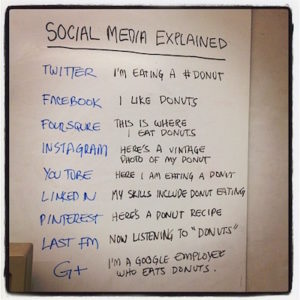 Instagram, Facebook, Google Posts, and Pinterest are great opportunities to share. Don’t forget Twitter. You’ve got options!